Primeira imagem do buraco negro Sagitário A*: o “anel” de luz no centro da Via Láctea

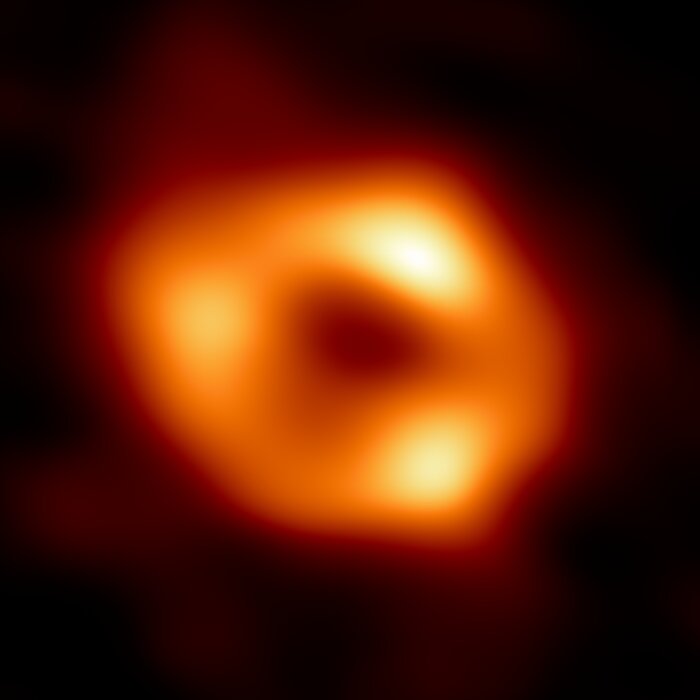
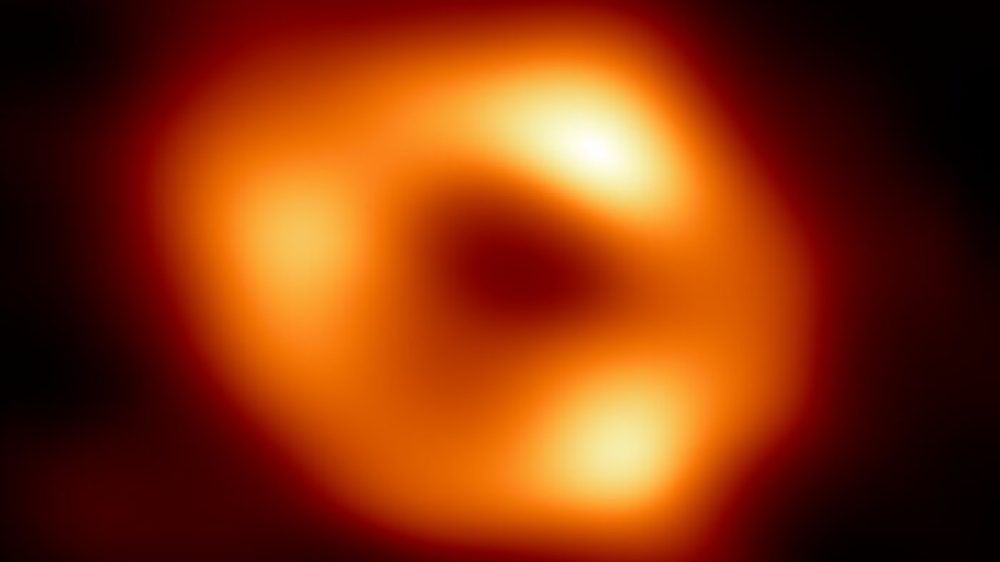
This is the first image of Sgr A*, the supermassive black hole at the centre of our galaxy. It’s the first direct visual evidence of the presence of this black hole. It was captured by the Event Horizon Telescope (EHT), an array which linked together eight existing radio observatories across the planet to form a single “Earth-sized” virtual telescope. The telescope is named after the event horizon, the boundary of the black hole beyond which no light can escape.   Although we cannot see the event horizon itself, because it cannot emit light, glowing gas orbiting around the black hole reveals a telltale signature: a dark central region (called a shadow) surrounded by a bright ring-like structure. The new view captures light bent by the powerful gravity of the black hole, which is four million times more massive than our Sun. The image of the Sgr A* black hole is an average of the different images the EHT Collaboration has extracted from its 2017 observations.  In addition to other facilities, the EHT network of radio observatories that made this image possible includes the Atacama Large Millimeter/submillimeter Array (ALMA) and the Atacama Pathfinder EXperiment (APEX) in the Atacama Desert in Chile, co-owned and co-operated by ESO is a partner on behalf of its member states in Europe.
Getting your Trinity Audio player ready...

O que você está vendo nessa imagem

This is the first image of Sgr A*, the supermassive black hole at the centre of our galaxy. It’s the first direct visual evidence of the presence of this black hole. It was captured by the Event Horizon Telescope (EHT), an array which linked together eight existing radio observatories across the planet to form a single “Earth-sized” virtual telescope. The telescope is named after the event horizon, the boundary of the black hole beyond which no light can escape.   Although we cannot see the event horizon itself, because it cannot emit light, glowing gas orbiting around the black hole reveals a telltale signature: a dark central region (called a shadow) surrounded by a bright ring-like structure. The new view captures light bent by the powerful gravity of the black hole, which is four million times more massive than our Sun. The image of the Sgr A* black hole is an average of the different images the EHT Collaboration has extracted from its 2017 observations.  In addition to other facilities, the EHT network of radio observatories that made this image possible includes the Atacama Large Millimeter/submillimeter Array (ALMA) and the Atacama Pathfinder EXperiment (APEX) in the Atacama Desert in Chile, co-owned and co-operated by ESO is a partner on behalf of its member states in Europe.

O centro escuro não é o buraco negro “em si” (que não emite luz), mas a sombra: uma região onde a gravidade é tão intensa que a luz ao redor é desviada ou capturada. Em volta, aparece um anel brilhante formado por gás muito quente orbitando o buraco negro e emitindo radiação no rádio — exatamente o tipo de “assinatura” que a teoria prevê para esse cenário. :contentReference[oaicite:1]{index=1}

Quem é o “Sgr A*” no centro da Via Láctea

Sagitário A* (lê-se “Sagitário A-estrela”) é o buraco negro supermassivo no centro da nossa galáxia. Há décadas, astrônomos observam estrelas orbitando algo invisível, compacto e extremamente massivo ali — mas faltava a evidência visual direta. Essa imagem fecha esse ciclo: ela é o retrato do ambiente imediatamente ao redor do buraco negro. :contentReference[oaicite:2]{index=2}

Como “fotografar” algo que não pode ser visto

A imagem foi produzida pelo Event Horizon Telescope (EHT), uma rede global de radiotelescópios que opera como um “telescópio do tamanho da Terra” usando uma técnica chamada interferometria de base muito longa (VLBI). Em vez de uma câmera comum, o EHT combina sinais de vários observatórios para alcançar resolução suficiente para “enxergar” estruturas tão pequenas quanto o anel ao redor da sombra. O resultado final é uma média construída a partir das observações realizadas em 2017. :contentReference[oaicite:3]{index=3}

Por que essa imagem é tão importante

  • Evidência direta: mostra a assinatura visual esperada de um buraco negro supermassivo no centro da Via Láctea.
  • Gravidade extrema: o “anel + sombra” permite comparar tamanho e forma com previsões da relatividade geral.
  • Astrofísica do gás: revela como plasma quente se comporta nas vizinhanças imediatas de um buraco negro.
  • Comparação histórica: reforça o salto científico iniciado com a imagem do M87* — agora dentro da nossa própria galáxia.

Em termos simples: não é só uma imagem bonita — é um teste do nosso entendimento de gravidade e matéria em um dos ambientes mais extremos do Universo. :contentReference[oaicite:4]{index=4}

Perguntas frequentes (FAQ)

Isso é o buraco negro “de verdade”?

Não. O buraco negro não emite luz. A imagem mostra a sombra do buraco negro (região escura) e o gás brilhante ao redor, visto em rádio.

Por que parece um “donut”/anel?

Porque a gravidade curva a trajetória da luz e concentra a emissão em uma região anelar. A parte central fica escura por conta do aprisionamento/deflexão da luz perto do buraco negro.

Por que foi tão difícil obter essa imagem?

O Sgr A* está relativamente “perto” em termos galácticos, mas o gás ao redor muda rapidamente e o alvo é pequeno no céu. Por isso, foi necessário um telescópio virtual do tamanho da Terra e muita reconstrução computacional.

Fonte: ESO — First image of our black hole (eso2208-eht-mwa) .